


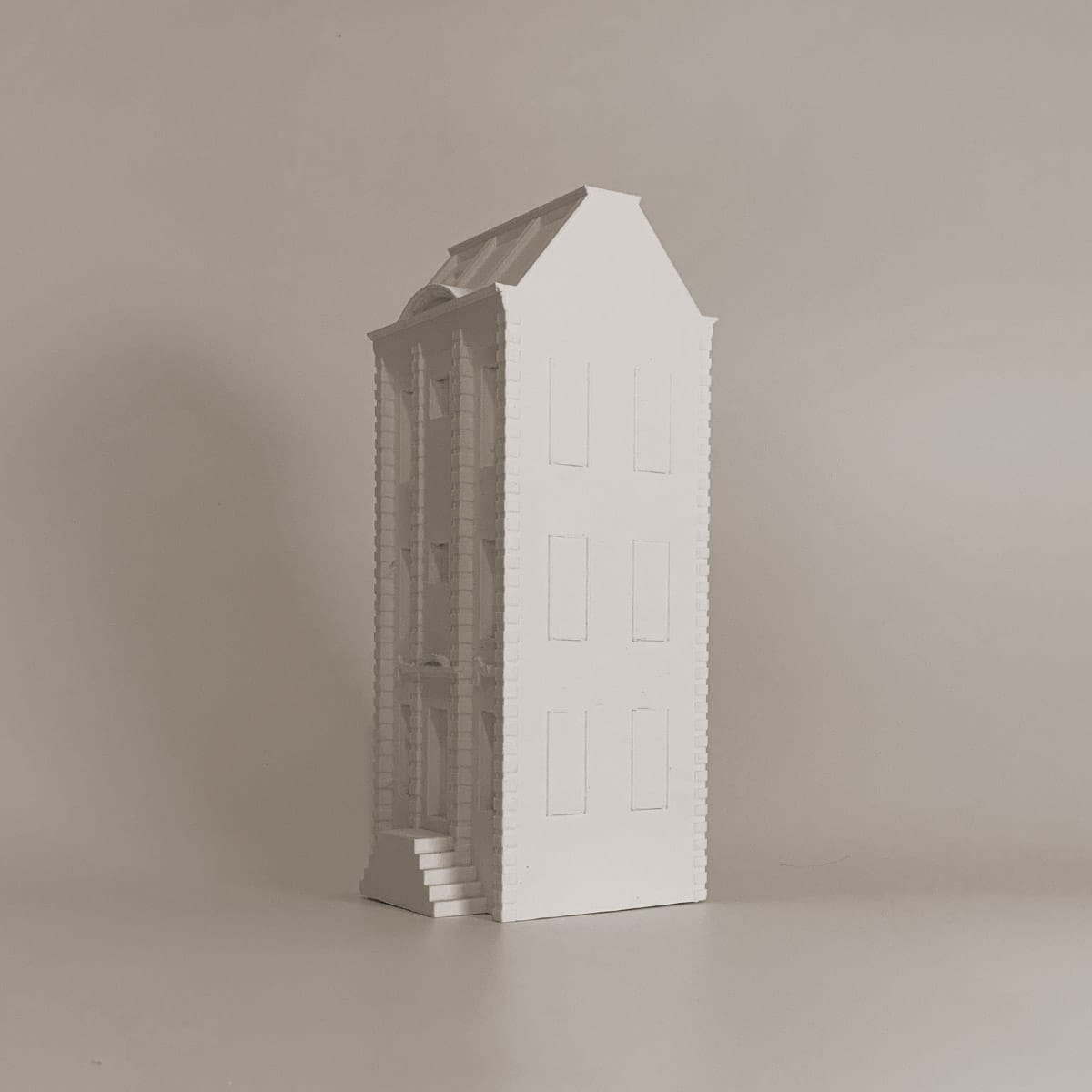

Keizersgracht 814 (building)
Price range: € 44,95 through € 149,95
SKU:
A stately building on Keizersgracht, the second of Amsterdam's three main canals that together form the canal belt, is located between Herengracht and Prinsengracht.
| Dimensions | N/A |
|---|
We design ourselves
All models are designed by ourselves and then printed in our 3D printing studio. This way we can switch quickly, make small series and still remain creative. Moreover, within the manufacturing industry we are purely Dutch in this way and we do not have to have anything produced abroad.
The productionproces
- The models are printed with high-quality 3D printers
- After printing, they are finished by hand
- Then they get a white coating for extra protection
Materials
- The models are made of Bio plastic (PLA)
- Only suitable for indoor use and do not place in direct sunlight
- It is non-toxic, paintable and easy to rinse off
- If properly maintained, it will last at least 10 years
Two versions
House for Scale offers both a whole Building design as a Facade with a view .

Up to 4 sizes
Each format is approximately 30% larger in scale than its slightly smaller brother. So an XL size is about twice as high, wide and deep compared to an S size.

In September 1614 the idea arose to turn the Keizersgracht into a chic boulevard without water, following the example of Lange Voorhout in The Hague. This has been abandoned for a number of reasons. The vroedschap suspected that the future buyers of plots on the Keizersgracht wanted to be able to reach their home or warehouse by boat. Other considerations may have been the need for water storage, the easier supply of construction and embankment material, but above all the shortage of embankment material. At the same time, the construction of the fortifications also required a lot of embankment material. In November 1615 the allotment on the east side was completed. At 30 feet, the plots were given the same width as at the Herengracht. Construction progressed quickly: in 1618 there were hardly any undeveloped plots. The part between the Leidsegracht and the Amstel belongs to the fourth expansion (1658). In 1663 the actual digging of this part of the Keizersgracht started. In 1667, both parts of the Keizersgracht were connected.
Productdetails

Quality in detail
Different sizes


 EN
EN  NL
NL